
ALE at IRSC 2026: Building Railway Safety with Frontline Workers
The Federation of European Train Drivers’ Unions contributed to the international debate on railway safety, highlighting the importance of human factors, operational experience and workers’ participation in technological innovation.
Lisbon, 13 October 2026 The Federation of European Train Drivers’ Unions (ALE) participated in the International Railway Safety Council (IRSC 2026), held in Lisbon, Portugal, contributing to discussions on the challenges facing railway safety and the essential role of frontline professionals.
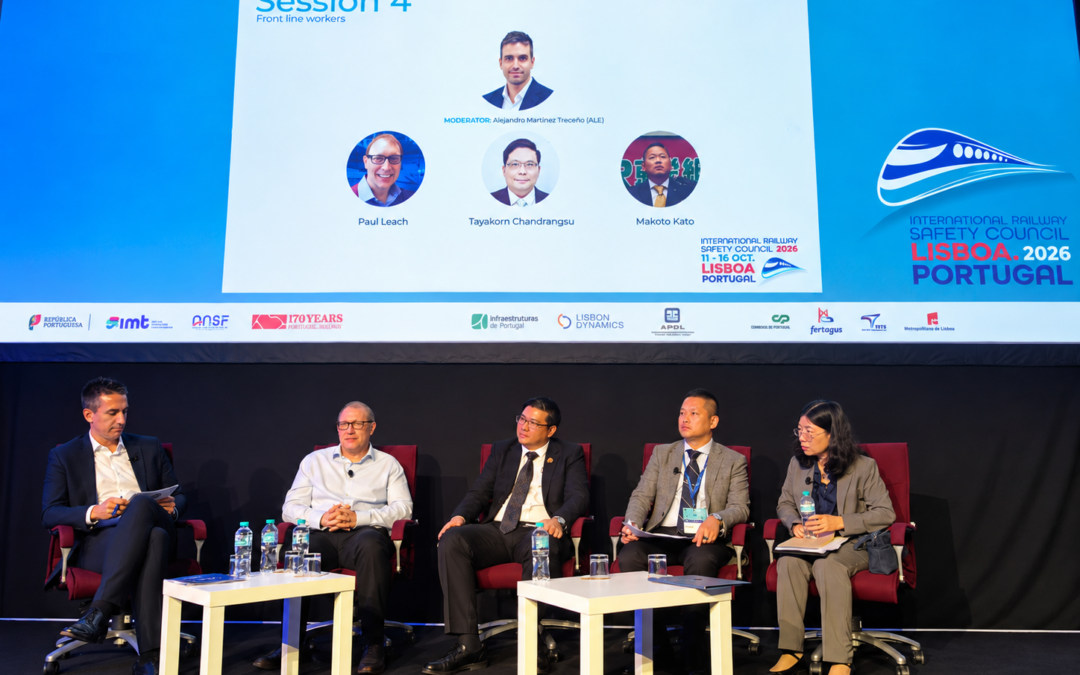
ALE was represented by its Secretary General, Alejandro Martínez Treceño, who moderated Session 4 “Front line workers”, bringing together international experts to explore how operational experience, technological developments and human factors can contribute to safer railway operations.
International perspectives on railway safety
The session featured three presentations addressing different but complementary aspects of railway safety:
- Paul Leach explored driver alertness and fatigue risk management, highlighting the importance of understanding human performance and its implications for operational safety.
- Dr Tayakorn Chandrangsu, from Thailand, presented technological approaches to improving safety in railway operational areas, including the use of LiDAR-based monitoring systems and data collection.
- Makoto Kato, from Japan, addressed the management of large-scale railway disruptions, sharing insights into operational resilience and the challenges of maintaining safety under exceptional circumstances.
Together, these contributions demonstrated how technological innovation, organisational preparedness and human expertise must work together to strengthen railway safety.
Technology WITH workers, not simply FOR workers
One of the main conclusions highlighted by ALE was that technological progress alone does not guarantee safer railway operations.
The effectiveness of new systems depends not only on their technical capabilities, but also on how they are designed, implemented and integrated into everyday working practices.
For ALE, this leads to a fundamental principle:
“We need technology developed WITH workers, not simply FOR workers.”
Train drivers and other frontline railway professionals possess operational knowledge that cannot be fully replaced by technical data, automated systems or theoretical assessments.
Their experience provides essential insights into real working conditions, human factors, operational risks and the practical consequences of new technologies.
Equally important is the meaningful involvement of workers’ representative organisations throughout the development and implementation of technological and regulatory initiatives.
Consultation should not be limited to the final stages of a project, once its main decisions have already been taken. Effective participation must begin at the design stage and continue through implementation, evaluation and continuous improvement.
Human factors at the heart of railway safety
The discussions reinforced the importance of adopting an integrated approach to safety, combining technological development with human expertise and organisational responsibility.
Digital monitoring, automation and advanced data analysis can provide valuable opportunities to identify risks and improve operational performance. However, these tools must support professional judgement and contribute to safer working conditions.
For ALE, technological innovation should strengthen the capacity of railway professionals to perform their duties safely, while recognising the importance of training, fatigue management, effective communication and operational experience.
Safety is not achieved by technology in isolation, but through the interaction between people, technology and the organisations responsible for railway operations.
Strengthening the voice of train drivers in international forums
ALE’s participation in IRSC 2026 reflects its continued commitment to ensuring that train drivers’ professional experience is represented in European and international discussions on railway safety.
The Federation considers dialogue between railway authorities, infrastructure managers, operators, technical experts and workers’ representatives essential to developing effective and sustainable safety policies.
ALE would like to express its appreciation to the organisers of IRSC 2026 for the invitation, as well as to the speakers and participants for their valuable contributions and the constructive exchange of experiences.
The central message is clear: the future of railway safety must combine technological progress, human expertise and meaningful workers’ participation.
As railway systems evolve, ALE will continue advocating for an approach in which frontline professionals are not merely the recipients of change, but active participants in shaping safer railways for everyone.